Showing posts with label Elizabeth Gaskell. Show all posts

Wednesday, February 9, 2011

A Moorland Cottage?... on a walk to Hilltop Farm

Thanks to the Gaskell Blog which is hosting the Group Read of Moorland Cottage, I ordered a copy of Elizabeth Gaskell's short novel and am presently enjoying a visit to the countryside in Victorian England.
 The first chapter paints us a picture that reminded me very much of my trip to England's Lake District last July. According to the Gaskell blog Elizabeth Gaskell wrote this work while staying near Lake Windermere, so it is no wonder that my memories of the area kept popping up while I read her lyrical descriptions.


Most comfortable shoes ever!
 I did a lot more walking than I was used to when I was visiting England.  I had hoped to do so and thankfully had brought some comfortable walking shoes, but little did I know how grateful for them I would be.  
While staying at Lake Windermere I had expected to catch a bus to Hilltop Farm, but when I discovered I would have to wait at least an hour for the bus, I decided to walk. Uphill. For over an hour.

That may not sound like much to you heel-toe speedsters, you marathon trainers, you healthy go-getters, but to a couch potato who's bottom is usually firmly ensconced in front  of a television or computer, this little jaunt was an event of gargantuan proportions. Thankfully, we were fully able to appreciate  the beauty along the way due to the frequent rest stops. *Gasp!*
I didn't need to worry that my husband was being held up by my lack of physical fitness. He was suffering from a knee injury and wearing a knee brace to keep the swelling down, so he was even more eager to pause than I was.

 Here are Elizabeth Gaskell's directions to Moorland Cottage:


If you take the turn to the left, after you pass the lyke-gate at Combehurst Church, you will come to the wooden bridge over the brook
(Okay, so it's not a lyke-gate, but it's such a pretty picture! Can we pretend that there is a wooden bridge and a brook over there behind the hedge? hmmm?)

 Keep along the field-path which mounts higher and higher, and, in half a mile or so, you will be in a breezy upland field, almost large enough to be called a down, where sheep pasture on the short, fine, elastic turf.


  You look down on Combehurst and its beautiful church-spire.

(At least I think this was a church.) It doesn't have much of a spire though. I seem to remember it being more brown.  That is what inspired me to start singing "The Little Brown Church in the Vale". O come, come, come, come..... (Nevermind --- off on a tangent again!)


The path goes down a green abrupt descent; and in a basin, surrounded by the grassy hills, there stands a dwelling, which is neither cottage nor house, but something between the two in size. Nor yet is it a farm, though surrounded by living things.


Well, unfortunately I skipped a bit of her lovely description because I didn't have a corresponding picture. You can see a house in the distance behind the greenouse. This is my imaginary Moorland Cottage.
  At the time I took these pictures though, I was wondering if I were anywhere near Hilltop Farm (which was my ultimate destination).  I assumed it was at the top of a hill, (and I knew I was because the road sloped downhill after here) so it made sense that it must be very close.  When we stopped at the nearest pub and asked directions we discovered we had another 3 miles to go!!

I will be posting later about what we saw at Hilltop Farm, (and yes, it was worth the effort).  The only thing that would have made the walk even more worthwhile would be if I had seen a sight such as this:


He looks a bit surprised to see me!
photo courtesy of Richard Armitage Net
"Are you stalking me, Phylly?"
No! *Gasping* Honestly! It was a complete coincidence running into you like this!
*collapses*

Sunday, October 31, 2010

A Dark, Dark Tale...


This is one of my very favourite children's picture books which I love to read to young children at this time of the year. Written and illustrated by Ruth Brown, it is delightfully scary as it leads the reader (or listener) to a surprising climax!  I got the best response from the 4 years olds who were wide-eyed with suspense and then laughed uproariously at the ending.

Here is a Youtube video of the story being read on a British children's programme called "Flicks". If you don't want to see the introductory part just skip ahead to the 3 minute mark for the beginning of the story.
A Dark, Dark Tale on video.

For more information about this author/illustrator, please see this article:
Ruth Brown (1941–) Biography - Personal, Addresses, Career, Honors Awards, Writings, Adaptations, Sidelights


Brown's story begins "on a dark, dark moor" which I was happy to describe to the children because I had finally visited "the moors" this past July when I went to see the home of the Bronte family in Haworth.  I wish I had spent more time there, in order to really get a feel for the place. But this website has some lovely pictures of the moorlands. I imagine at night and in bad weather, it must look very spooky indeed!

While in Edinburgh, we took a nighttime tour through the narrow streets of the city and then down into the underground to the Vaults which are believed to be haunted and where we heard a spine-tingling ghost story!
Here are some of my pictures from this tour, but make sure you watch the videos on the link above, as they were very similar to what we saw.
 
These evil instruments were displays at the Torture Museum which was part of the tour. I'd tell you what they were for, but it was so ghastly that I couldn't take it all in! That people could be so cruel to each other is just mind boggling to me!


Underground vault
Wiccan temple
These two pictures were taken in the underground vaults. The first is not a very good one, as it was so dark I did not really know what was going to be in the picture. The second one is a room in one of the underground vaults which was used for Wiccan religious ceremonies until the High Priest felt the presence of a dangerous spirit which so terrified his group that they apparently abandoned the room to move to a more favourable area within the underground.

Our tour guide relating another dark, dark tale
This picture was taken of our tour guide while he told us a tragic and horrifying story about a group of homeless people who were trapped in the underground during a great fire in the city.


And now here is a ghost story by none other than Elizabeth Gaskell. It is a radio program version of      The Old Nurse's Story dramatized by Weird Circle Theatre.
Sorry for the cigarette ads on this radio show...Remember this was made back in the day when smoking was extremely popular.  Now just hearing the ads is almost as unnerving as the story itself! :)


Currently on the BBC's Season 9 of Spooks (a.k.a. MI-5),  
Lucas North is living his own dark, dark tale. 
One can only hope that he, like his name "Lucas" which means light, will not be extinguished, and that his character will remain undimmed by the storm of plot contrivances with which the scriptwriters have attempted to smother him.
This pumpkin carving idea is thanks to an anonymous poster at Richard Armitage Fan Blog.


Wednesday, September 29, 2010

Elizabeth Gaskell's Bicentennial

September 29th 2010 is the 200th year since the birth of my favourite author Elizabeth Gaskell. I came to appreciate her talents by introduction to the miniseries North and South, produced by the BBC in 2004, starring my favourite actor, Richard Armitage. Since watching that beautiful adaptation I have read the book on which it was based, as well as several more of her works.

I have mentioned Mrs. Gaskell in several posts so rather than repeat myself, here is a link to the one in which I visit her home in Manchester.

There are quite a few bloggers out there in blogland who are celebrating her birthday today. My blogger buddies Maria Grazia, Charleybrown, Traxy, and Jane Greensmith have all done posts in her honour. We all wish more people were aware of the talent of this often overlooked, but immensely talented Victorian author. If you haven't already read one of her novels or short stories, you will be very pleased and surprised if you do!

One of the little details that makes me so fond of Richard Armitage (who plays mill owner John Thornton in North and South) is that he actually read Mrs. Gaskell's book before he even showed up for the audition. Although it may sound like an obvious thing to do, I doubt that very many actors would take the time to do this. 


Here's hoping that more people discover the works of Elizabeth Gaskell so that she gets all the attention and appreciation that she deserves.

Tuesday, September 14, 2010

Let me be plaid!

Sorry to go all stereotypical on you, but I can't post about Scotland without mentioning that exceptional piece of a Scotsman's wardrobe referred to as "the kilt". Well, you can't ignore them, they are all over the place.  I, for one am a huge fan of anyone wearing something a little different than the norm. If I were a man I would be bored to tears wearing pants (sorry) trousers all the time!
  Of course we all wonder what might be hidden underneath the kilt.
Any idea to which clan these tartans belong?
Our guide to Edinburgh Castle
Street music
I realize that in North America the terms tartan and plaid are virtually interchangeable, but in the land of the kilt, this is definitely not the case. So in the interest of clarity, here is the actual meaning:
Tartan:  
a design of straight lines, crossing at right angles to give a chequered appearance, esp the distinctive design or designs associated with each Scottish clan. 
Plaid:
1. A rectangular woolen scarf of a tartan pattern worn over the left shoulder by Scottish Highlanders.
2.  a. Cloth with a tartan or checked pattern.
     b. A pattern of this kind.

So a plaid would be a scarf or blanket worn (perhaps with a kilt) in Scotland, but elsewhere plaid simply refers to the chequered design of the fabric.

 Clear as mud? Yeah, I thought so! Moving on....


Hunter plaid
My husband wanted to purchase a kilt (until he realized that the full regalia was over a thousand pounds!).  There seemed to be nothing in between this exorbitant amount and a cheap Halloween costume version.  As we didn't really have time for comparison shopping, a bit of wishful window shopping is all it amounted to. As his mother's maiden name was Hunter we would like to consider this his family tartan.

Ghastly Gaskell plaid


Molly Gibson (played byJustine Waddell) in the BBC's production of Elizabeth Gaskell's Wives and Daughters. When she is unexpectedly invited to Hamley Hall, she finds her wardrobe is not up to snuff. Her father suggests she should buy a few new store-bought dresses.

'Well, but it seems people consider you as a young woman now, and so I suppose you must run up milliners' bills like the rest of your kind. Not that you are to get anything anywhere that you can't pay for down in ready money. Here's a ten-pound note; go to Miss Rose's, or Miss anybody's, and get what you want at once. The Hamley carriage is to come for you at two, and anything that is not quite ready, can easily be sent by their cart on Saturday, when some of their people always come to market. Nay, don't thank me! I don't want to have the money spent, and I don't want you to go and leave me: I shall miss you, I know; it's only hard necessity that drives me to send you a-visiting, and to throw away ten pounds on your clothes. There, go away; you're a plague, and I mean to leave off loving you as fast as I can.'
'Papa!' holding up her finger as in warning, 'you are getting mysterious again; and though my honourableness is very strong, I won't promise that it shall not yield to my curiosity if you go on hinting at untold secrets.'
'Go away and spend your ten pounds. What did I give it you for but to keep you quiet?'
Miss Rose's ready-made resources and Molly's taste combined, did not arrive at a very great success. She bought a lilac print, because it would wash, and would be cool and pleasant for the mornings; and this Betty could make at home before Saturday. And for high-days and holidays - by which was understood afternoons and Sundays - Miss Rose persuaded her to order a gay-coloured, flimsy plaid silk, which she assured her was quite the latest fashion in London, and which Molly thought would please her father's Scotch blood. But when he saw the scrap which she had brought home as a pattern, he cried out that the plaid belonged to no clan in existence, and that Molly ought to have known this by instinct. It was too late to change it, however, for Miss Rose had promised to cut the dress out as soon as Molly had left her shop. 

Mall-teasers plaid
Another Gaskell plaid below. Jo Joyner as Fanny Thornton wears this plaid monstrosity to visit Margaret Hale in North and South.
Big bad plaid


While trying to board the Royal Yacht Brittannia (which we were unfortunately  too late to do), we hoofed it through a shopping mall in Leith (Edinburgh's northern port) where I took this picture at a ladies clothing store sporting quite the selection of plaid clothing items. (I couldn't resist the pink deer's head either! LOL)


Now, excuuuuse me while I go off on a bit of a tangent, but I had to include this trailer for comedian 
Steve Martin's homage to Film Noir just for the title alone -- "Dead Men Don't Wear Plaid"!
It's a pretty funny movie, (if you like that sort of goofiness -- I DO!) from back in 1982.


Now ... here is Canadian comedian Mike Myers wearing a kilt and toasting that inimitable Scottish actor Sean Connery at the American Film Institute awards show.  I couldn't have found a better film clip if I had paid these people! (If you look carefully, you will catch a glimpse of Pierce Brosnan too!)


Thank you loyal readers. If you have read this far you certainly deserve a treat.
So here you are...


Lucas McNorth clad in plaid

Thanks to my dear friend TeeTotallyNot for her wonderful artwork!

Tuesday, August 31, 2010

Visiting the Brontës

Welcome to Haworth
Most of my visit to the UK was spent in the north of  England as I was visiting my daughter who is finishing her Masters Degree at the University of Leeds.  As I was checking out things to see and do in and around Leeds, West Yorkshire I came upon some information about the town of Haworth -- where lo and behold, the Brontë sisters lived and wrote! Apparently it is England's most visited literary shrine. Well, the librarian in me, could not pass that one up! Plus, there was the added attraction of taking a steam locomotive to get there!
From Keighley to Haworth by Steam Train
We took a regular train from Leeds to Skipton and got off at Keighley (which I discovered is pronounced Keef-Lee not Kay-Lee as I thought). Keighley is where we got on the steam train to Haworth. This train runs almost daily in the summer months, but otherwise only on the weekends.
***UPDATE***
(03/04/11)
If you read the comments you might notice that JaneGS has corrected me on the pronounciation of Keighley which I not only got wrong because of the spelling but even misheard from the ticket seller's pronounciation!  Jane has a lovely post about this same topic at her blog called Reading, Writing, Working, Playing.
Just to be sure I remember how to pronounce Keighley properly -- "KeiTHley" here is an audio file made for me by RAFrenzy (thanks Frenz!) of Richard Armitage speaking this word.

 Here is a Youtube video that was very similar to my trip 
and shows the town of Haworth better than my snapshots. The video also has a fairly complete recount of the of the Bronte family history. So please forgive me for not reiterating it here. I will just say that their lives were short, but glorious --  and their fame survives to nourish their much-loved village.


Haworth is such a beautiful village, that I wished I had booked at a B&B for an overnight so I could have had more time to explore the town. We had a drink at a lovely pub after our tour but as usual, had to rush off to catch the bus back to Keighley and the train back to Leeds.
The surrounding countryside
Luckily, I was able to take pictures (without a flash) inside the  
Brontë Parsonage Museum.

The study

The kitchen

Check out this webpage for 360 degree views of all the rooms. Be careful! If you click too fast you might get dizzy!

A view of the back garden with the statue of the three sisters.


 Charlotte's wedding bonnet and veil
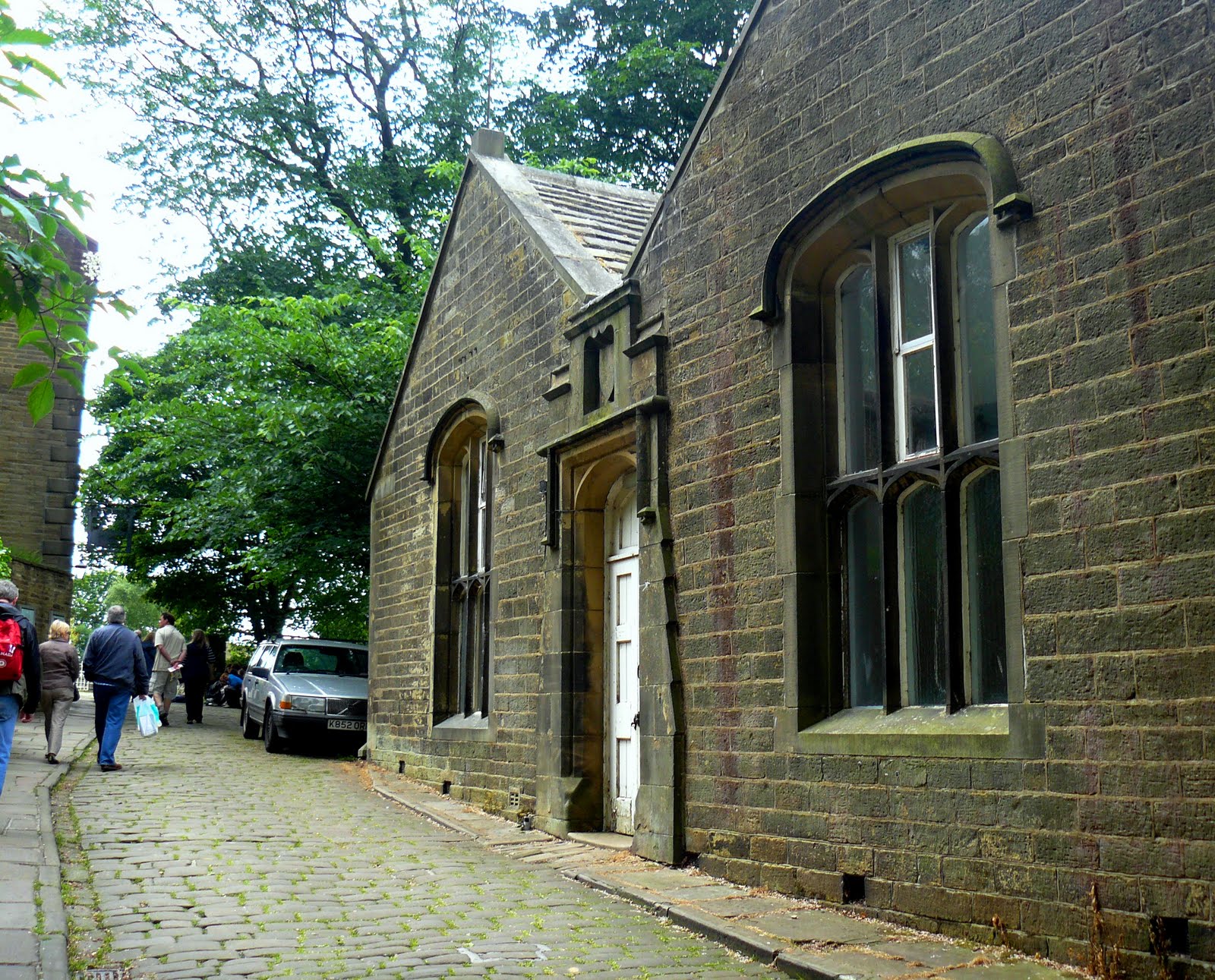
Both Charlotte and Ann were governesses (and both wrote about governesses). There were extremely few acceptable options for educated women to support themselves in those days.  When Charlotte's aunt Bramwell died in 1842, Charlotte returned home and taught at this little school very near the parsonage.


Charlotte was the only one of her sisters to be married. Although she was cautioned against it, Charlotte seems to have had a very happy (although tragically short) marriage to Arthur Nicholls.

Charlotte's husband Arthur Bell Nicholls


One of Charlotte's dresses


Charlotte's writing desk

Copies of the Brontë sisters' famous literary accomplishments
Here is a list of books written by this talented family of authors, poets and artists. Some of their works can be read online.

Now this book was quite exciting for me to see, as I am more of a fan of Elizabeth Gaskell than any of the Bronte sisters. (Sorry, Traxy@The Squeee!)  Elizabeth Gaskell, (author of North and South) became a good friend to Charlotte Brontë, so much so, that Charlotte's father requested that Mrs. Gaskell should write Charlotte's biography after her untimely death shortly after her marriage in 1855.
The biography of Charlotte Brontë by Elizabeth Gaskell


Here is one of those things that make you go hmmm....(?)

Charlotte Brontë was born in the village of Thornton.  In Elizabeth Gaskell's novel 
North and South, her main male character's name is John Thornton. (co-incidence?)

Richard Armitage as John Thornton in North and South (2004)


Thursday, August 26, 2010

Elizabeth Gaskell wuz here...

Our first night in England was spent in Manchester and before I left the next day, I was determined to see the house where Elizabeth Gaskell had lived while she wrote many of her greatest works.  My husband and I got in a taxi and on the way to the train station, we took a little side trip to get some photographs of the exterior. I knew that the house wasn't open for tours (what a disappointment), but I had to at least see the outside, after coming all the way from Canada!

84 Plymouth Grove, Manchester, UK
2010 marks the bicentennial of the birth of this great author and as I stood outside her home I got quite choked up about it. I'm sure the taxi-driver was wondering why an old house was bringing tears to my eyes, and my husband probably thought I was just disappointed I couldn't go in for a tour, but really, just the thought that I was actually standing outside the house of Elizabeth Gaskell, one of my most favourite authors -- the more I learn about her and the more I read her works -- this was what was making me so overcome with emotion! (Okay, possibly the jet lag might also have had something to do with it!)


The sign on the fence says: Manchester's neglected treasure is being restored.  Well, it's about time, I say! Why is every other English author more revered than this one? Gaskell was an immensely talented author, so much so that Charles Dickens (who called his “dear Scheherazade”) persuaded her to contribute stories to his literary magazine, "Household Words".  Her works are as lively and entertaining today as they were when they were written in the middle of the 19th century.
 Referred to as Mrs. Gaskell, and the wife of a Unitarian minister, some may have dismissed her writings as preachy Victorian chic lit.  But those people were so wrong!

Elizabeth Gaskell is difficult to categorize (especially so to Victorian society) because she had so many differing interests.  She was highly educated, she travelled, she was very social, with a wide group of friends, aquaintances and correspondents, she was a minister's wife (with all the duties both real and expected that that entails) as well as a mother of several children (some who died in childhood). Most famously she was an author -- a very successful one! It is a wonder that she found time to write the novels and short stories that told about the working class people and their terrible living conditions in northern industrial cities, or the idyllic village life before the coming of the industrial revolution, and all with an eye to a colourful realism, in that no one is all good or all bad and there is always a bit of amusement to be found in the simplest things.


Other Sources of information about Elizabeth Gaskell:
  • A paper written by Kay Saucier discusses Elizabeth Gaskell's religious beliefs and how they influenced her writing. Entitled Elizabeth Gaskell, British Unitarianism and Darwinism, it sheds light on how Gaskell's writings fit in with the time and the society within which she lived.
  • An article entitled Elizabeth Gaskell's Manchester by Alan Shelston for the Elizabeth Gaskell Society Journal, (Vol. 3, 1989) 
  • A great review of her novel North and South is on Gathering Books blog 
  • My blogger buddy Maria Grazia from FLY HIGH! has a fascinating post about Mrs. Gaskell's very romantic visit to Rome. 
  • An article from The Daily Mail  The Amazing Secret Life of Cranford creator Elizabeth Gaskell. by Tony Rennell.
  • A post at Lizr128's Blog compares the work of Elizabeth Gaskell to Jane Austen.
  • Here is a Youtube video interview by Penguin Classics on Air  with screenwriter Sue Birtwistle who makes a comparison between Elizabeth Gaskell and Jane Austen
 

Books by Elizabeth Gaskell include:
These are the Penguin Classics versions, which I enjoy because of the extensive introductions and background notes. -- The covers are nice too!

Mary Barton (1848)
On my wishlist
Ruth (1853)
Also on my wishlist


Cranford (1853)
Reading it now.


Watch Cranford trailer here.
Cranford and its sequel stars Judy Dench (2nd from left).


North and South (1855)
My favourite!


BBC (2004)
 Well, what can I say about this adaptation? It is simply the best period drama miniseries I have ever seen! Seeing the miniseries inspired me to read the book, which did not disappoint. Although there were a couple of scenes changed from the book to the television production, on the whole it was a remarkably faithful reimagining of the story. 
To me, the story of North and South seems to be the closest to Mrs. Gaskell's real life experience with romance. She seems to have had a happy married life. One can only hope that Mr. Gaskell was as dreamy as is the character of John Thornton as played by Richard Armitage!


Here is a trailer for the miniseries North and South starring Richard Armitage 
and Danielle Denby-Ashe. HeathDances has kindly given me permission to show it here.


 Sylvia's Lovers (1863)
On my wishlist
 Cousin Phillis (1865)
(Short stories) Read and loved it!


Wives and Daughters (1866)
Enjoyed it very much.


Sadly, Wives and Daughters was Elizabeth's last book, as she died at the age of 55 just before its completion. Many critics consider this her finest work, and I know one blogger who likes this adaptation even better than North and South! Too bad Richard Armitage isn't in it!


Wives and Daughters 1999
Save the Best for Last (Roger & Molly) / by KDRainstorm

If you are lucky enough to live in Great Britain or will be travelling there soon, and you are a Gaskell fan, here is a website with information about touring the area and a schedule of events for Gaskell's bi-centenary.